
Law School Admission Requirements: Your Complete Guide to Getting Into Law School
Introduction
Choosing to study law is one of the most transformative career decisions you can make. Whether your goal is to become a corporate attorney, a human rights advocate, or a legal scholar, your journey begins with understanding the Law School Admission Requirements that determine who gets accepted.
Law schools around the world look for more than just high grades — they evaluate your critical thinking, analytical ability, communication skills, and commitment to justice. The application process can seem overwhelming, especially if you’re unsure about eligibility, documentation, or exam requirements.
This comprehensive guide breaks down everything you need to know about Law School Admission Requirements, including academic qualifications, entrance exams, personal statements, and interviews. We’ll also highlight how resources like SchoolOfLaw.net can help applicants prepare smarter and stand out during the competitive admission process.
Understanding Law School Admission Requirements
Every law school sets specific entry conditions to ensure that students are prepared for the intellectual challenges of legal education. While these criteria vary by country and university, certain core Law School Admission Requirements are almost universal.
1. Academic Qualifications
Strong academic performance is the foundation of law school admission. Most institutions require a completed undergraduate degree from a recognized university.
-
For Pakistani law schools: Applicants generally need at least 50% marks in their intermediate or undergraduate studies. The five-year LL.B. (Hons) programs usually admit students after high school (F.A./F.Sc./A-Levels), while three-year LL.B. programs are open to graduates.
-
For international law schools: You’ll need an accredited bachelor’s degree and official transcripts.
Academic consistency is vital because admission committees see your GPA as a predictor of your ability to manage the demanding workload of law school.
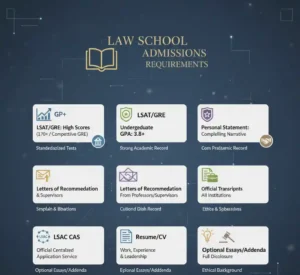
2. Entrance Exams
Entrance tests are another key part of Law School Admission Requirements, as they assess logical reasoning, reading comprehension, and analytical writing skills.
Pakistan
In Pakistan, the Law Admission Test (LAT), conducted by the Higher Education Commission (HEC), is mandatory for most LL.B. programs. The LAT includes sections on English, Urdu, general knowledge, Islamic studies, and essay writing.
Internationally
-
United States: The LSAT (Law School Admission Test) is required by nearly all accredited U.S. law schools.
-
United Kingdom: The LNAT (National Admissions Test for Law) is used by several top UK universities.
-
Canada and Australia: Some universities also accept the LSAT, while others have their own institutional tests.
Preparing for these exams with practice materials and mock tests from reliable sources — such as SchoolOfLaw.net — can make a significant difference in your performance.
3. English Language Proficiency
For non-native English speakers, most universities abroad list language proficiency among their Law School Admission Requirements.
Common tests include:
-
IELTS: Usually a minimum score of 6.5 or 7.0 overall.
-
TOEFL: A score of 90–100 (iBT) is often required.
-
PTE Academic: Some law schools accept a minimum of 58–65.
Strong communication is central to legal studies, so demonstrating language competence is essential.
4. Personal Statement or Statement of Purpose
Beyond grades and scores, your personal statement gives the admissions committee insight into your motivation and potential. It’s one of the most crucial yet overlooked Law School Admission Requirements.
A compelling statement should explain:
-
Why you want to study law
-
What drives your passion for justice or legal reform
-
How your experiences have shaped your career goals
-
Why you’ve chosen that particular law school
Use vivid storytelling and sincerity. Admissions officers can immediately sense whether an essay is authentic. Platforms like SchoolOfLaw.net provide detailed guides and examples to help applicants craft strong, personal, and persuasive statements.
5. Letters of Recommendation
Another standard among Law School Admission Requirements is submitting recommendation letters. Law schools use these to evaluate your academic integrity, leadership, and interpersonal skills.
Aim for:
-
Two academic references from professors who know your work well.
-
One professional or character reference, if applicable.
These letters help humanize your application and show that respected mentors can vouch for your potential to succeed in legal studies.
6. Resume or Curriculum Vitae (CV)
A well-organized CV summarizing your educational background, extracurricular activities, and professional experiences can strengthen your law school application. Many Law School Admission Requirements now explicitly ask for this document.
Highlight:
-
Academic awards and honors
-
Debate, moot court, or legal aid experience
-
Community service or leadership roles
Even if you’re applying directly after undergraduate study, showing initiative outside the classroom signals your readiness for a rigorous law program.
7. Interview Stage
Some universities — particularly abroad — include interviews as part of their Law School Admission Requirements. These may be formal, semi-structured, or conversational.
The goal is to evaluate:
-
Communication and reasoning skills
-
Professionalism and maturity
-
Ethical awareness and passion for law
Practicing mock interviews on platforms such as SchoolOfLaw.net can help you gain confidence, refine your speaking skills, and prepare for common interview questions.

Law School Admission Requirements in Pakistan
If you’re planning to study law in Pakistan, it’s crucial to understand how local Law School Admission Requirements work.
Most recognized law schools — such as Punjab University Law College, SZABUL, and International Islamic University — require the HEC LAT score, academic transcripts, CNIC, and passport-size photos.
Many institutions also prefer candidates with active participation in debates or community service, as these qualities demonstrate leadership and communication skills crucial for the legal field.
SchoolOfLaw.net is an excellent resource for Pakistani students. It offers guidance on LAT preparation, scholarship updates, and insights into accredited law programs recognized by the Pakistan Bar Council.
Law School Admission Requirements Abroad
When applying internationally, requirements differ slightly by region:
United States
-
Bachelor’s degree in any discipline
-
LSAT score
-
Personal statement and recommendations
-
Proof of English proficiency (for international applicants)
United Kingdom
-
A-levels or equivalent qualifications
-
LNAT score (for select universities)
-
Personal statement via UCAS
-
Proof of English proficiency
Canada and Australia
-
LSAT (for most schools)
-
Academic transcripts
-
Personal statement and references
-
Proof of English proficiency
Meeting these Law School Admission Requirements often involves months of planning — especially for standardized test preparation, document attestation, and application essays.
Financial Aid and Scholarships
Many students overlook the financial aspect when reviewing Law School Admission Requirements. Scholarships can significantly reduce the burden of tuition fees.
SchoolOfLaw.net frequently features updates about national and international law scholarships, along with eligibility criteria and deadlines. Students can also find mentorship programs and tips for writing scholarship essays.
How to Strengthen Your Application
Here are proven strategies to improve your chances of meeting and exceeding Law School Admission Requirements:
-
Start early — gather documents and register for tests at least a year before deadlines.
-
Maintain a strong GPA — law schools look for consistent performance.
-
Engage in extracurriculars — debate clubs, mock trials, or legal internships demonstrate passion.
-
Refine writing skills — legal education demands clarity and precision.
-
Seek feedback — use advisors or resources like SchoolOfLaw.net for review.
Common Mistakes to Avoid
While applying, many students make avoidable errors that hurt their chances of admission:
-
Submitting incomplete forms
-
Missing test score deadlines
-
Writing vague or generic personal statements
-
Ignoring specific Law School Admission Requirements listed on university websites
Carefully read each school’s admission page and follow instructions precisely.
FAQs: Law School Admission Requirements
1. What are the basic law school admission requirements in Pakistan?
Applicants must have completed at least 12 years of education (FA, FSc, or A-Levels) and pass the HEC Law Admission Test (LAT).
2. Do I need to take the LAT for every law school in Pakistan?
Yes. All HEC-recognized universities require LAT results for LLB admissions. SchoolOfLaw.net provides updates on LAT schedules and preparation resources.
3. What documents are required for law school admission abroad?
You’ll need academic transcripts, test scores (LSAT or LNAT), letters of recommendation, personal statement, and proof of English proficiency.
4. Can I apply to law schools abroad after completing my LLB in Pakistan?
Yes. Many students pursue LLM degrees abroad after completing their LLB. SchoolOfLaw.net lists admission requirements for top LLM programs worldwide.
5. How can SchoolOfLaw.net help me with admissions?
The platform offers detailed admission guides, scholarship listings, LAT/LSAT preparation tips, and expert advice to simplify your application process.